
Visiting Poznań, Poland: Things to See, Do, and Eat in One of Europe's Hidden Gems


Poznań is Poland's fifth-largest city, located in the western part of the country. It's not as well-known as a tourist destination as Kraków or Gdańsk, but it frequently comes up in conversations as "a great, liveable city." Visiting it in person, I completely understood why. My stay was just one night, but I fell in love with the atmosphere of the place.
What Is Poznań? Poland's Most Underrated Historic City

When people think of historic Polish cities, Kraków tends to steal the spotlight — and for good reason. Wawel Castle, one of Europe's largest market squares (Rynek Główny), medieval architecture around every corner. It's an undeniably impressive city. But it's also large, busy, and well and truly on the tourist trail.
Poznań offers something different.
Once the capital of Poland, it has no shortage of history or architectural character. But what makes it special is its scale — the Old Town is compact enough to explore entirely on foot, with everything worth seeing within easy walking distance of each other. No hopping between districts, no exhausting full-day slogs. Just a pleasant, unhurried stroll through centuries of history.

A Prestigious University Named After a National Poet: Adam Mickiewicz University

This was honestly one of the most beautiful university campuses I'd ever seen. The main campus, located right next to the Old Town, is so impressive you just want to stop and take photos. There's also a bronze statue of Adam Mickiewicz — Poland's beloved national poet whose likeness you see everywhere across the country.

Naturally, a university bearing such an important figure's name is one of Poland's leading institutions. It appears to be actively international, with a wide range of English-language programs. The cosmopolitan feel I noticed walking around Poznań suddenly made a lot of sense.
Beyond this university, Poznań is home to many other institutions including Poznań University of Economics, and the city is known for its youthful energy alongside its historic atmosphere.
Loads of Cool, Bohemian Cafés

One small regret from this trip was not being able to spend more time in the stylish cafés. Time constraints (and a limited caffeine tolerance…) forced me to pass them by. But as I walked around, I kept thinking: oh, that one looks great! And that one! — they were everywhere.
There's a free-spirited, bohemian vibe to the place, yet the streets themselves are clean and well-kept. That balance felt distinctly Poznań. With so many stylish young people around, next time I'd love to take it slow and really café-hop properly.


The Photogenic Old Market Square with Its Pastel-Coloured Buildings

With limited time, the Old Town was the obvious first stop — and the main square in particular was incredibly photogenic. I ended up taking shot after shot. It was the Christmas season, and an ice-skating rink had been set up in the square, buzzing with children.
Poznań's Symbol: The Two Goats

You'll spot two goats absolutely everywhere in this city — on souvenirs, signs, wall art, you name it. And yes, Poznań is synonymous with the two goats that emerge from the clock tower at the centre of the square. Why goats? After looking it up, it turns out to be a re-enactment of Poznań's "Goat Legend."
The legend goes that in 1551, during the opening ceremony of the Town Hall, two goats intended as ingredients for the banquet managed to escape just before being cooked, fleeing up into the tower where they began to fight. That scene became the symbol of Poznań.
Interesting. The goats actually reminded me of another Polish city — Lublin.
Having come all this way, there was no leaving without seeing the clock tower goats. So I waited for the top of the hour.


Camera at the ready, I waited — but only the bell rang. No goats appeared. It turns out they only come out at noon each day. Gutting. I should have done my research. Well, now I have one more reason to come back to Poznań.

A Park and River Right Next to the Old Town

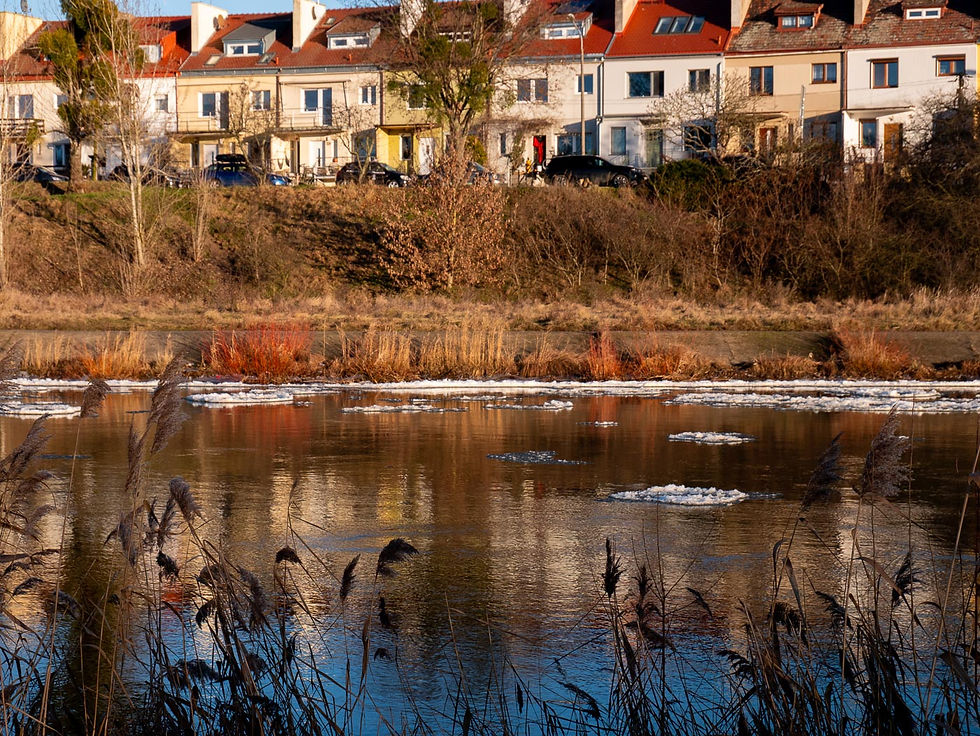
Old town centres are usually crowded — but in Poznań, there's actually a park right alongside the Old Town, running along a river. A perfect escape when the crowds get to you. Walking along the riverbank in winter, I found myself imagining what it must be like in summer, with people sprawled out on the grass having picnics.
Poznań's Local Speciality: Not Quite a Croissant

Poland is full of delicious food, and the must-eat local treat in Poznań is the Rogal Świętomarciński. I thought "Rogal" just meant croissant — and was promptly corrected by my Polish wife.

Since it's a local speciality, I figured it would be easy to find anywhere, and waited until I was properly hungry. But it was Christmas week, and many shops were closed to begin with. I spotted a few bakeries, but some had none left for the day... In the end, I couldn't get my hands on one. Heartbreaking. That's a mission for next time.
For the curious — what exactly is a Rogal Świętomarciński?
It's a traditional Poznań sweet with over 100 years of history, made with dough containing white poppy seeds and marzipan, coated in sugar icing, and topped with almonds and other nuts.
Unlike a croissant, it's apparently quite dense and substantial. Oh, how I wish I'd managed to try one.
The Striking Pink Fara Church

Walking through Poznań's Old Town, one building immediately caught my eye: a vivid pink church. Tucked at the end of a narrow alley lined with colourful buildings on either side, it stands out dramatically. The alley is so narrow that you can't actually fit the whole church in a single photo — but the presence it commands is extraordinary.

Stepping inside... equally breathtaking. The interior is absolutely stunning.

Around the back of the church, there's a sort of courtyard space — where, of course, I spotted goats again.

Visiting Poznań - Summary

Walking the streets of Poznań, I finally understood why people who live in Poland consistently say it's a great city. The highlights are compactly clustered around the Old Market Square, making it easy to cover on foot. It's a historic city with real depth, yet the whole place has a young, free-spirited, bohemian energy running through it. This visit was a short winter stay, but next time I want to come in summer and take things slowly — café-hopping, trying the local food, really savouring everything.


Comments